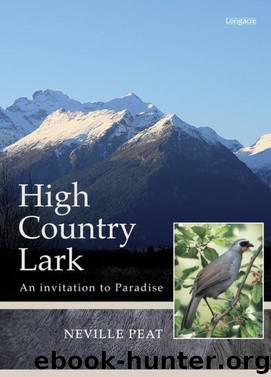
High Country Lark by Neville Peat
Author:Neville Peat [Neville Peat]
Language: eng
Format: epub
ISBN: 9781775535386
Publisher: Penguin Random House New Zealand
Published: 2013-12-09T16:00:00+00:00
Classic portrait: Bill O’Leary, in three-piece suit and thigh gumboots, and his packhorse, Dolly, at the start of a back-country expedition from the Head of the Lake. This 1938 photograph by Thelma Kent is the best-known portrait of the legendary prospector. THELMA RENE KENT COLLECTION, ALEXANDER TURNBULL LIBRARY REF F-8752-1/2
CHAPTER 5
Going West
Human geography aficionados might care to take note: a road-end in a frontier land like the Head of Lake Wakatipu, where settlement rubs shoulders with a mountain fastness, is bound to contain more than its share of larger-than-life characters. They stand out not only because they are resourceful, self-reliant and skilled at many things, but also because their personalities leave a lasting impression. It is as if they have become deeply etched into the landscape. They seem to ‘wear’ the land, as the Lark would say.
Bill O’Leary wore the land. He also wore a three-piece suit, with fob watch in the waistcoat pocket, and thigh gumboots. A late 1930s photograph of him by Christchurch photographer Thelma Kent portrayed him dressed this way. He is standing by his beloved, big-footed packhorse Dolly, a seventy-year-old man with a snow-white beard setting out from Elfin Bay for the wilds of the Olivine country west of the Main Divide. Piled on Dolly are sacks stuffed with provisions for a three-month expedition. He has a wide-brimmed hat to protect his bald head from sun and rain, and the gumboots are reinforced with leather soles and hobnails for negotiating slippery stream beds and gripping steep terrain. It is the portrait of a legend of the south: Arawata Bill.
Although his nickname acknowledges one of the great rivers and valleys of South Westland, where he worked as a ferryman, roadman and cattle musterer, Bill O’Leary strongly identified with the Head of Lake Wakatipu. Off and on, over a period of forty-odd years starting in the late 1890s, he sought treasure in far mountains but repeatedly came back to the Glenorchy district to work for his keep and the cost of restocking the next expedition. Of wiry, athletic build, he could carry a pack of over twenty kilograms into the hills.
William James O’Leary was born on 28 October 1865 at Wetherstons, a goldfield near Lawrence in Central Otago. He was the second oldest of eight children of Timothy and Mary O’Leary (actually, Bill’s mum and dad were married at Milton by a Scottish ancestor of mine, Alexander Ayson, a pioneer South Otago teacher). Young Bill grew up in a goldmining environment, and carried a gold-fossicking interest into the mountains and valleys out west. He was fit enough even into his seventies to be roaming largely trackless country. To mark passes and trails through high places he would erect piles of stones. In his seventy-eighth year, however, Arawata Bill appeared to Glenorchy friends to be ailing, and they arranged for him to go to a Catholic old people’s home in Dunedin. For a while he appreciated the care and attention he received from the Little Sisters of the Poor
Download
This site does not store any files on its server. We only index and link to content provided by other sites. Please contact the content providers to delete copyright contents if any and email us, we'll remove relevant links or contents immediately.
The Vikings: Conquering England, France, and Ireland by Wernick Robert(84379)
Ali Pasha, Lion of Ioannina by Eugenia Russell & Eugenia Russell(40318)
The Conquerors (The Winning of America Series Book 3) by Eckert Allan W(37982)
The Vikings: Discoverers of a New World by Wernick Robert(37006)
Cecilia; Or, Memoirs of an Heiress — Volume 1 by Fanny Burney(32636)
Cecilia; Or, Memoirs of an Heiress — Volume 2 by Fanny Burney(32010)
Cecilia; Or, Memoirs of an Heiress — Volume 3 by Fanny Burney(31996)
Empire of the Sikhs by Patwant Singh(23135)
The Secret History by Donna Tartt(19294)
Hans Sturm: A Soldier's Odyssey on the Eastern Front by Gordon Williamson(18649)
Cat's cradle by Kurt Vonnegut(15441)
Pimp by Iceberg Slim(14664)
Sapiens: A Brief History of Humankind by Yuval Noah Harari(14458)
Norse Mythology by Gaiman Neil(13457)
Talking to Strangers by Malcolm Gladwell(13439)
Leonardo da Vinci by Walter Isaacson(13411)
4 3 2 1: A Novel by Paul Auster(12510)
Underground: A Human History of the Worlds Beneath Our Feet by Will Hunt(12145)
The Radium Girls by Kate Moore(12093)
